
Football is one of those things that can bring a room to life. Mention a team, a player or a big match and suddenly everyone has an opinion. Someone remembers where they were when a particular goal was scored. Someone else insists their team was robbed. Families argue over players, friends make predictions and, for a few hours, everything else can wait.
Across Africa, football can carry that same sense of excitement, but it can also carry something deeper. It can be about home, identity, pride and belonging. It can connect generations and, for people living away from the country they were born in, it can sometimes be one of the things that keeps a connection to home alive.
When we talk about Africa and football, however, the story is often quite predictable. We hear about the extraordinary talent coming out of the continent, the young player who has been spotted by a European scout, the latest African star playing for a major European club or the next big transfer. Those stories are part of the reality, but they can also make African football seem as though its main purpose is to produce talent for somebody else’s footballing stage. The history and culture around the game are much bigger than that.
Football spread across Africa during the colonial period through schools, workplaces, missions, ports, railways and towns. But Africans did not simply receive the game and leave it unchanged. Communities formed their own clubs, competitions and traditions, and football became part of everyday social life. In a number of countries it also became connected to growing movements for independence and national identity. Football gave people a way to represent their communities and, increasingly, their nations at a time when those identities were themselves being shaped. The history of the game in countries such as Algeria, Ghana and South Africa shows that football has often existed alongside much bigger social and political changes.
The creation of the Confederation of African Football, CAF, in 1957 was another important moment. Egypt, Sudan, Ethiopia and South Africa were the founding members, although apartheid policies meant South Africa’s participation quickly became a point of dispute. The first Africa Cup of Nations was held in Sudan that same year, with Egypt becoming the first champions. What began with only a handful of teams has grown into one of the most important football competitions in the world. The Africa Cup of Nations is not simply a tournament for deciding who is the best team on the continent. For supporters, it is an opportunity to see their country represented on a stage that belongs to Africa.
That sense of representation matters. A national football shirt can mean far more than the eleven people wearing it. For someone watching from Accra, Kigali, Lagos, Dakar or Cairo, it can represent home. For someone living in Newcastle, London, Manchester or elsewhere in the diaspora, it can represent a part of themselves that is not always visible in their everyday life. You can be thousands of miles away and still find yourself shouting at the television because your country’s team has just conceded a goal.
That is one of the reasons football is so useful when we talk about culture. It gives us a very ordinary and familiar way into conversations about identity. We might not always sit down and discuss migration, belonging or our relationship with our parents’ country of birth, but put a national team match on the television and suddenly those conversations can happen naturally. Who are you supporting? Why that team? Where did your family come from? Did you grow up watching them? Do your children support the same team? These seemingly simple questions can open up much bigger stories.
Of course, African football has also produced some extraordinary individuals. George Weah, Roger Milla, Abedi Pelé, Jay-Jay Okocha, Didier Drogba, Samuel Eto’o, Yaya Touré, Sadio Mané and Mohamed Salah are just some of the names that have become recognised far beyond the continent. Their careers have helped challenge old assumptions about where world-class footballers come from and what African players can achieve. George Weah, for example, became the first and, to date, only African player to win the Ballon d’Or, doing so in 1995.
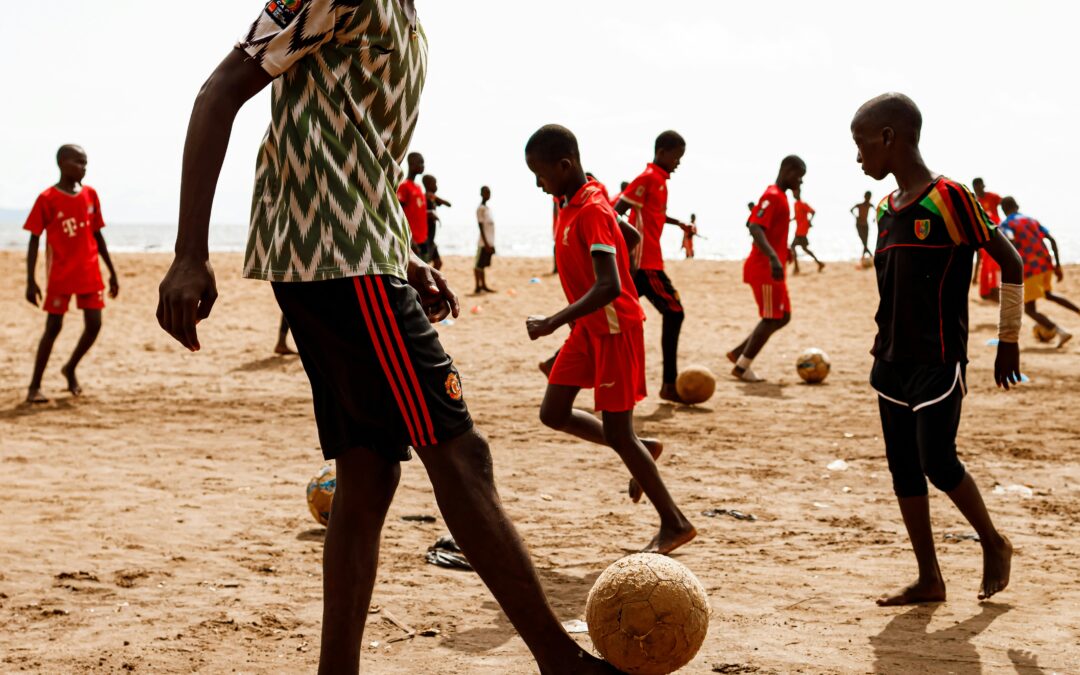
But even these stories can sometimes be told too narrowly. We celebrate the player who makes it to Europe while forgetting the thousands of children playing on local pitches who may never leave their home country. We talk about famous clubs while overlooking the local teams that have spent decades building football communities. We celebrate the finished product without always asking what exists underneath it: the coaches, families, volunteers, supporters, facilities and local clubs that help create a footballer in the first place.
And there is another part of the story that deserves more attention: women’s football. For too long, conversations about African football have been overwhelmingly focused on men. Yet women’s football across the continent has its own history, its own achievements and its own challenges. Nigeria’s Super Falcons have dominated African women’s football for decades, while countries such as South Africa, Zambia and Morocco have increasingly made their mark internationally. Morocco’s women’s team reaching the final of the 2022 Women’s Africa Cup of Nations and later becoming the first Arab or North African team to reach the knockout stage of the Women’s World Cup in 2023 were significant moments, not just for football but for representation.
Then there are the moments that become part of collective memory. Cameroon reaching the World Cup quarter-finals in 1990 remains one of the most memorable performances by an African team at the tournament. Ghana came within a penalty kick of reaching the semi-finals in 2010. In 2022, Morocco went further than any African men’s team had gone before, reaching the World Cup semi-finals in Qatar. These moments were celebrated around the world, but they also meant something particular to people across Africa and the diaspora. They challenged the idea of what was expected from an African team and created memories that will be passed on.
The 2026 World Cup has already given the continent another reason to look at the changing story. Africa had ten teams represented at the tournament, its largest ever number, following the expansion of the competition. That expansion does not solve the structural inequalities that exist within global football, but it does provide more opportunities for African nations to compete on the biggest stage.
And perhaps this is where the conversation needs to go next. African football should not always be discussed through the lens of what it can give the rest of the world. Yes, African players are an important part of European football. Yes, clubs across Europe have benefited enormously from African talent. But African football has its own audiences, its own histories, its own heroes and its own future.
There is something quite powerful about recognising that.
Football can tell us a lot about Africa without reducing Africa to a single story. It can show us creativity and competition, but also community and history. It can tell us about migration and the diaspora, about colonialism and independence, about gender and opportunity, about pride and belonging. It can even show us how something introduced from outside can become deeply embedded in local culture and take on a meaning of its own.
Perhaps that is why football remains such a useful starting point for conversations about African heritage. You don’t have to be an expert in African history. You don’t need to know every statistic or remember every tournament. You might simply have a favourite player, remember watching a match with your family or still have an old football shirt tucked away somewhere.
Start there.